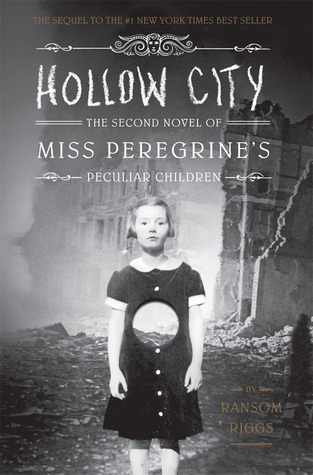
The second Novel to the Miss Peregrine's Home for Peculiar Children series, Hollow City, is about the peculiar children and their headmistress, Miss Peregrine, searching for another ymbryne that can help Miss Peregrine turn human again.
Since I wasn't such a big fan of the first book, I didn't expect to like the second one much, either. But although I've had my prejudices, I tried to be as objective as I could.
All the children did was look out for ymbrynes and, when confronted with wights/hollows, fight them. When reading the first book in the series I felt that the island, Cairnholm, had a certain charme to it that the second book, naturally, lacked. The group of children were always on the run, always tending to other peculiars in search for help which made the story not exactly credible and kind of rushed. In a sense I could feel they were on the run, but isn't it peculiar they seemed to know where to find others of their kind since they are said to be rare and well-hidden?
Nonetheless, I didn't expect the twist at the end. I wasn't sure whether I would pick up the third book in the series at all, since halfway through the book I didn't see any reason to do so, but now, for the sake of finding out what all the fuzz is about, I think I'm going to do so in the near future. And because the cliffhanger was surprisingly well done. Now, those were my issues with the story itself, let's move on to writing and characters.
I didn't feel like the characters evolved, they were more character tropes than actual breathing, developing characters. Enoch, the sarcastic pessimist and Bronwyn, the motherly figure (now that Miss Peregrine is temporarily gone) and so on. This, to me, seems rather unlikely because of the Second World War taking place during their time of journey. Sometimes the children seem rather frightened by the perspective of being hit by a bomb, but only temporarily do they care for their surroundings. I would have expected scars on their child-like souls with all the bombings around them.
Also, I had my issues with the voice of Jacob. Like in the first books he expresses himself in a way very unlike someone from the 21st century who's been educated.
He talks about tribes of people and groups of people with sheer prejudice. He claims to have gathered all his knowledge about gypsies and is now thinking about whether they're going to butcher the children or if they are naturally grumpy people. Or the freaks in the sideshow who he claims to be 'standard-issue sideshow fare'. It made me dislike him even more than I did in the first book. And then there's the romance with his grandfather's ex-girlfriend that both of them seem to take as it is and don't give it a second thought.
Now on to the writing.
The first few pages were surprisingly well-written. I really liked the way the author described the surroundings and the circumstances, but the more pictures the book withheld, the worse the writing and the descriptions became. I really had the feeling that the author relied too much on those pictures. Just to give you an example - the dog. You don't know what that dog looks like nor what kind of dog he is. And you won't know if you bought the audio book, because there's - of course - a picture of that dog that seems self-sufficient to the author, but not to me.
In the first book of the series I felt that the pictures were more or less forced to fit into the story, in Hollow City I had the impression the story was written to fit the pictures - which I didn't find appealing in both cases.
I won't make the mistake of accusing the author of the book for being disrespectful toward other people because of the ... peculiar views that Jacob has on some people that appear in the book. But there is one picture in the book that does indeed look like it's going along with the story very well, but it doesn't. When the peculiar children escaped the three wights disguised as soldiers and killed them, there is a picture of three people lying face-down to the ground. Those people are actual soldiers, and according to my knowledge do not seem to be alive.
I find this utterly disrespectful to make the reader dislike those men in the picture because of the things that characters in a book have done to the heroes. I have no words for it, really.
This book gets only 2 out of 5 stars because of the reasons I just stated. The cliffhanger and the questions still left to be answered are the only reasons to read the third book, for me, at least.

No comments:
Post a Comment